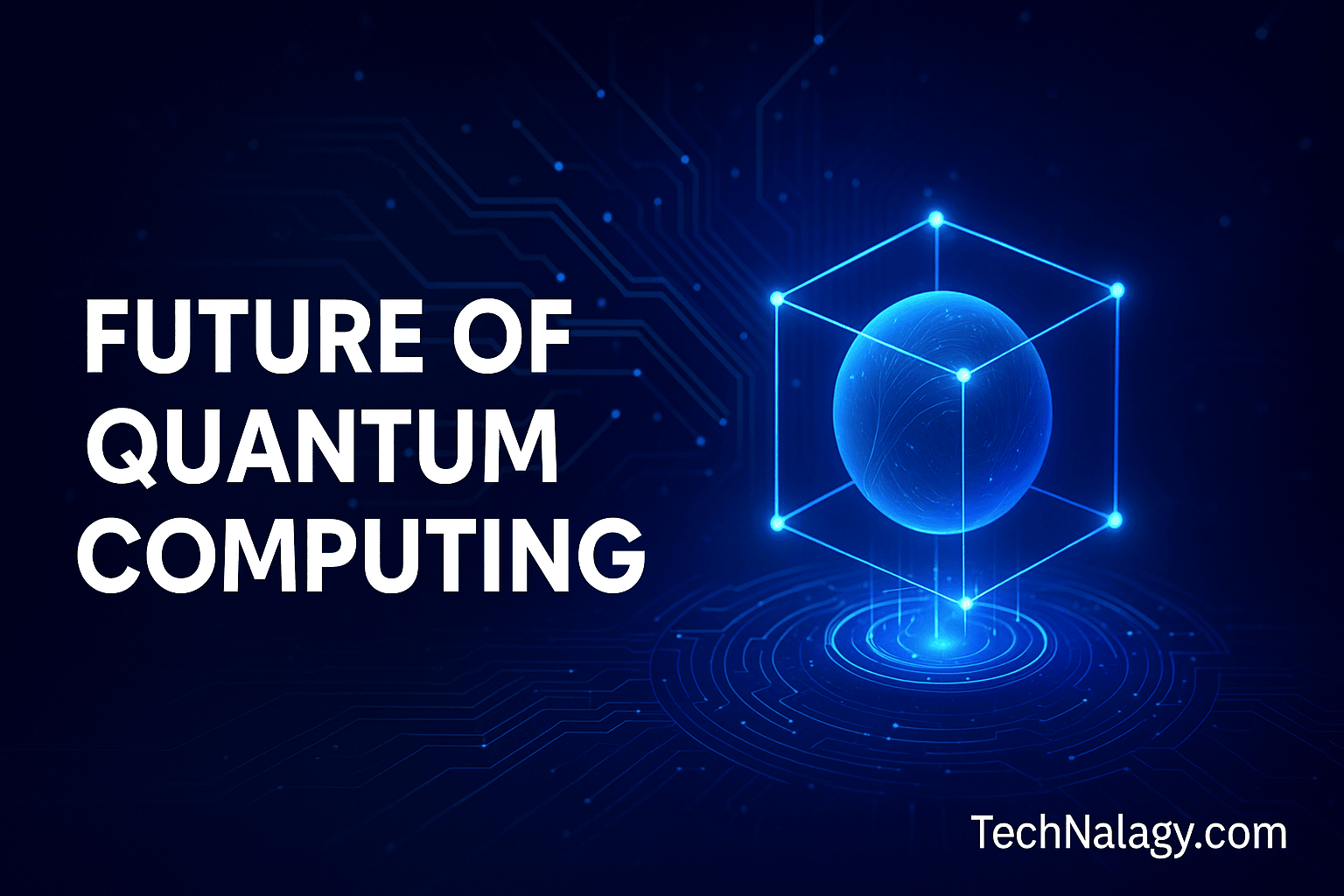
The Future of Quantum Computing in 2025: Global Impact, Use Cases & Challenges
Introduction: The Dawn of a Quantum Era
In the world of technology, few topics generate as much excitement and debate as Quantum Computing. As 2025 unfolds, researchers, governments, and corporations alike are racing to harness its transformative potential. Unlike classical computing, which relies on binary bits (0s and 1s), quantum systems use qubits, capable of existing in multiple states at once through superposition. This leap in computational power has the potential to reshape industries, economies, and even global security.
The future of Quantum Computing in 2025 is not about speculation anymore—it is about real-world progress, global competition, and breakthrough applications that can no longer be ignored.
Table of Contents
Understanding Quantum Computing in 2025
The Science Behind Quantum Computing
Quantum Computing is built on the principles of quantum mechanics—superposition, entanglement, and interference. Unlike traditional bits that are either 0 or 1, qubits can be both simultaneously. This property allows quantum machines to perform highly complex calculations at speeds impossible for even the fastest supercomputers.
For instance, a problem that may take a classical computer years to solve could be handled by a quantum processor in minutes. This makes Quantum Computing especially relevant for fields requiring massive simulations, like material science, cryptography, and artificial intelligence.
Key Technological Milestones by 2025
The year 2025 marks a significant milestone for the field. Companies like IBM, Google, and IonQ have already made progress toward scaling qubits and reducing error rates. IBM, in particular, has been at the forefront, providing cloud-based access to quantum processors for researchers worldwide.
👉 For an in-depth look at IBM’s innovations, visit IBM Quantum Computing.
At this stage, the industry has moved beyond theoretical hype to practical experiments and enterprise-ready solutions, paving the way for real-world deployment.
Global Impact of Quantum Computing
Transforming Industries Worldwide
The influence of Quantum Computing in 2025 is already being felt across multiple sectors:
- Finance: Banks use quantum algorithms for portfolio optimization, fraud detection, and risk modeling.
- Healthcare: Quantum simulations accelerate drug discovery, enabling breakthroughs in cancer treatments and vaccine development.
- Cybersecurity: Traditional encryption methods are vulnerable to quantum attacks, prompting research into post-quantum cryptography.
- Artificial Intelligence: Quantum-enhanced AI promises faster training of models, real-time decision-making, and smarter automation.
National Strategies and Investments
Governments recognize the strategic importance of quantum breakthroughs:
- The United States has strengthened funding under the National Quantum Initiative Act.
- China has built advanced quantum communication networks and is pushing for quantum supremacy.
- The European Union continues its Quantum Flagship program, fostering collaboration between academia and private industries.
This global race underscores the technology’s role as a geopolitical game-changer.
Real-World Use Cases of Quantum Computing
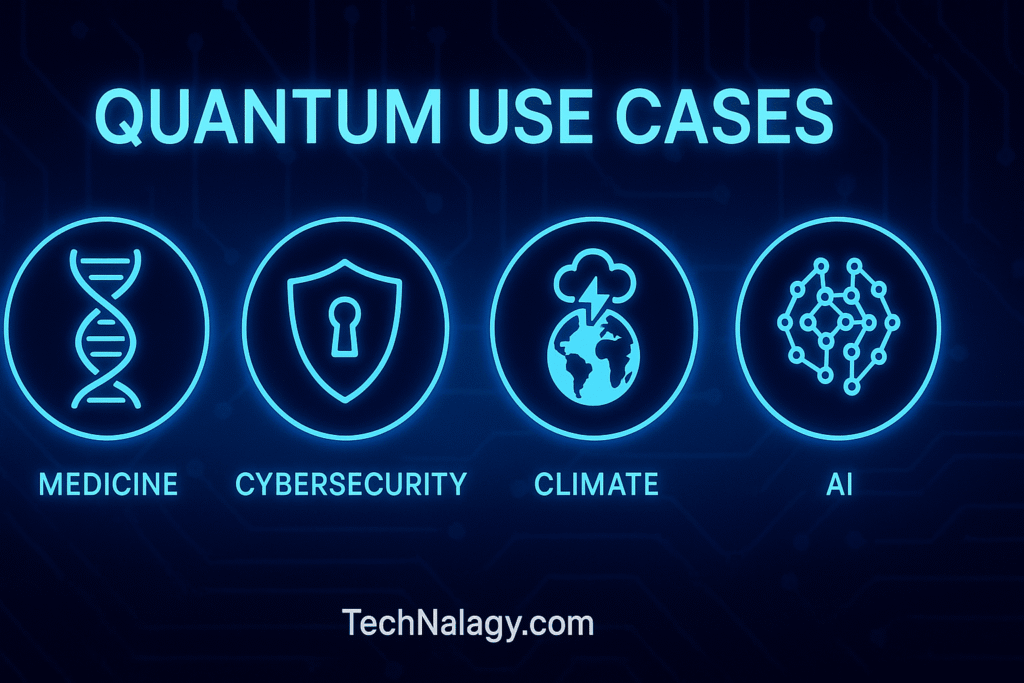
Healthcare & Drug Discovery
Pharmaceutical companies now use quantum simulations to model molecular interactions at an atomic scale. This reduces the time needed to design new drugs, making treatments more affordable and accessible.
Cryptography and Cybersecurity
Quantum Computing poses a serious threat to traditional encryption methods like RSA and ECC. Governments and corporations are investing in post-quantum cryptography to ensure data remains secure in a quantum-powered world.
Climate Change and Energy Solutions
Quantum systems are used to simulate climate models with higher accuracy, helping predict extreme weather events. They are also driving innovations in battery design and renewable energy, aiding the fight against climate change.
Challenges in Quantum Computing
Technical Barriers
Quantum systems face issues like noise, decoherence, and error correction, making reliable large-scale machines difficult to build.
Cost and Accessibility
Quantum hardware is still expensive, limiting access for small businesses. To address this, companies are offering cloud-based quantum services, democratizing access.
Ethical and Security Concerns
Quantum advancements raise ethical questions. For example, breaking modern encryption could compromise global security, while merging Quantum Computing with AI may create powerful tools that require strong governance.
Future Predictions and Innovations Beyond 2025
Breakthroughs Expected by 2030
Experts predict that by 2030, we will see quantum advantage—a state where quantum systems outperform classical ones in solving real-world problems consistently. This could lead to breakthroughs in personalized medicine, supply chain optimization, and advanced AI.
Quantum’s Role in Emerging Tech
Quantum Computing is not a standalone innovation. It will integrate with other technologies like AI, Blockchain, and IoT, creating powerful hybrid systems.
👉 For a broader perspective on transformative technologies shaping tomorrow, see Tech Trends 2025.
Global Collaborations and Competition
Tech Giants and Startups
Companies such as Google, Microsoft, and IBM continue to lead the charge, while startups like Rigetti and D-Wave are innovating faster in niche areas. Collaborations between universities, private firms, and governments are accelerating real-world applications.
Geopolitical Competition
The US and China are locked in a race for quantum supremacy, while Europe adopts a collaborative model through funding programs. This competition will likely define the global balance of power in technology.
Conclusion: The Quantum Leap Ahead
As we enter 2025, Quantum Computing is no longer a futuristic concept—it is a growing reality. While significant challenges remain, its impact on industries, economies, and global security cannot be overstated.
From drug discovery to cybersecurity, climate change modeling to AI acceleration, quantum breakthroughs are laying the foundation for a new digital era. However, success will depend on overcoming technical, ethical, and accessibility challenges, as well as fostering global collaboration.
The coming years promise not just incremental change but a paradigm shift—a true quantum leap into the future of computing.

Kamran Khatri is the founder of technalagy.com, where he shares insights on AI, future tech, gadgets, smart homes, and the latest tech news. Passionate about making innovation simple and accessible, he writes guides, reviews, and opinions that help readers stay ahead in the digital world.