How to Automate Your Entire Workflow Using AI Agents in 2025
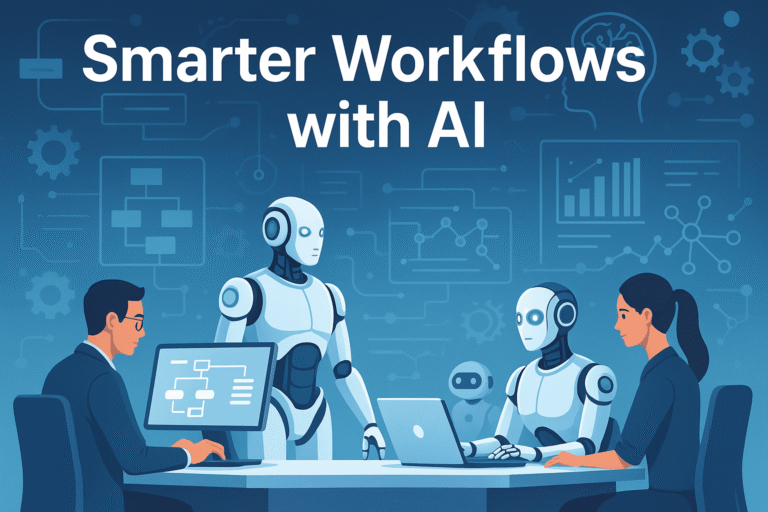
In 2025, AI Agents Automation has evolved from a futuristic concept into an everyday productivity powerhouse. The term AI Agents Automation 2025 refers to the integration of intelligent, autonomous digital assistants that can plan, execute, and optimize tasks with minimal human input.
From writing emails and managing projects to analyzing data and handling customer queries, AI agents are now reshaping how individuals and enterprises work. According to Gartner, by 2025 over 70 percent of global companies will rely on AI automation for key operational processes. This transformation signals a new era of intelligent efficiency—one where humans focus on creativity and strategy while AI agents handle repetitive execution.
Table of Contents
What Are AI Agents and How Do They Work?
AI agents are self-directed software entities built on machine learning and natural-language-processing models that can observe, reason, and act. Unlike traditional bots that follow static scripts, these agents understand context and make decisions dynamically.
Each AI agent consists of three functional layers:
- Perception – collecting data from apps, APIs, and user prompts.
- Reasoning – analyzing goals and selecting optimal actions.
- Execution – performing tasks such as drafting content, updating spreadsheets, or sending notifications.
For instance, a marketing AI agent might generate blog drafts, schedule them on WordPress, and post analytics updates to Slack—entirely on its own.
Why AI Agents Are the Future of Workflow Automation
Modern organizations demand speed, precision, and scalability. AI agents deliver all three.
Key advantages include:
- Time efficiency: They handle repetitive processes continuously, freeing hours of human labor.
- Error reduction: Intelligent algorithms minimize manual mistakes.
- Cost savings: Automation cuts operational expenses across departments.
- Continuous learning: Agents refine their output from user feedback and data patterns.
According to IBM’s overview of AI automation, businesses that integrate intelligent workflows experience up to 40 percent faster process efficiency and higher employee satisfaction. As adoption accelerates, AI Agents Automation 2025 is quickly becoming the foundation of digital transformation.
Step-by-Step Guide — How to Automate Your Entire Workflow Using AI Agents
Step 1: Identify Repetitive Tasks
Begin by mapping out your daily or team routines. Which actions are repetitive yet rule-based—email responses, meeting scheduling, or report generation? These are prime targets for automation.
Step 2: Choose the Right AI Automation Platform
Select a platform that supports agent-based workflow creation. Popular options in 2025 include Zapier AI, Notion AI Flows, ChatGPT Custom Agents, and AutoGPT Enterprise.
For an in-depth comparison, explore our AI Workflow Automation Tools Guide to find solutions suited to your organization’s scale and security requirements.
Step 3: Connect Apps and Integrate APIs
Most platforms allow drag-and-drop integration. Link core applications—Google Workspace, Slack, CRM, or Trello—so the agent can exchange data across them. Proper API connections ensure a smooth information pipeline between your business systems.
Step 4: Train Your AI Agents for Personalization
Personalization enhances relevance and accuracy. Teach the agent your writing tone, file-naming conventions, and scheduling preferences. Advanced systems in 2025 now support adaptive learning, enabling agents to evolve with each interaction.
Step 5: Monitor and Optimize Your Automated Workflow
Automation should never be “set-and-forget.” Review performance dashboards weekly, measure accuracy, and refine prompts or triggers. Continuous optimization guarantees long-term reliability and alignment with changing business goals.
Best Tools for AI Agents Automation 2025
Several cutting-edge tools dominate the automation landscape this year:
- ChatGPT 5 Custom Agents – ideal for conversational workflow execution.
- Zapier AI Workflows – connects thousands of web apps effortlessly.
- Relevance AI Orchestrator – enterprise-grade multi-agent collaboration.
- Taskade AI Agents – combines task management with real-time automation.
- Microsoft Copilot 365 – integrates directly into Office and Teams.
For a detailed overview of these platforms and their setup process, refer again to our AI Workflow Automation Tools Guide.
AI Productivity Tools That Complement Automation
While AI agents manage processes, supporting AI productivity tools enhance creativity and communication.
Writers rely on generative assistants for drafting; analysts use AI dashboards to visualize trends; and developers employ code-suggestion models for rapid deployment. Combining these utilities with automation multiplies output quality.
Discover additional recommendations in our post on Artificial Intelligence Tools, where we review top 2025 platforms boosting efficiency across industries.
Real-World Examples of AI Agents in Action
AI agents are now operational across nearly every professional field:
- Marketing: Automated campaign optimization and content scheduling.
- Finance: Invoice reconciliation and fraud detection.
- Education: Personalized tutoring bots for adaptive learning.
- Healthcare: Appointment triage and patient-record updates.
- IT Operations: Continuous system monitoring and ticket resolution.
Interestingly, many employees already deploy personal AI tools without formal approval—a phenomenon explored in Shadow Productivity 2025. This underground movement highlights the demand for faster, smarter workflows that official policies are only beginning to recognize.
Future of AI Agents Automation 2025 and Beyond
The next stage of automation goes beyond single-agent execution toward collaborative multi-agent ecosystems. Future AI networks will:
- Exchange context between agents for compound decision-making.
- Predict user intent using emotional-intelligence models.
- Operate within secure ethical boundaries through transparent AI governance.
By 2030, experts foresee “agent orchestration layers” that allow businesses to deploy hundreds of autonomous AI entities under unified oversight—ushering in a new digital workforce paradigm.
Challenges and Ethical Considerations
Despite their promise, AI agents introduce important concerns:
- Data privacy: Sensitive information must remain encrypted.
- Accountability: Who is responsible for an agent’s decision errors?
- Bias control: Algorithms must be audited to ensure fairness.
- Human oversight: Strategic supervision is essential to prevent over-automation.
Organizations implementing AI Agents Automation 2025 should establish transparent reporting mechanisms and compliance frameworks to maintain trust.
Conclusion — Embracing a Fully Automated Future
The journey toward full-scale AI Agents Automation 2025 is not about replacing humans; it’s about amplifying their potential. When routine tasks are automated, professionals can focus on innovation, leadership, and critical thinking.
Start small—automate one workflow, measure its impact, then expand systematically. Within months, the compounded productivity gains will redefine how your team works.
Automation isn’t the end of human creativity—it’s the beginning of intelligent collaboration between people and machines.
FAQs — AI Agents Automation 2025
Q1: What exactly is AI Agents Automation 2025?
It’s the 2025 evolution of intelligent digital agents capable of autonomously executing workflows using AI and integrated data systems.
Q2: Can AI agents replace human workers?
No. They augment human effort by handling repetitive processes, allowing employees to focus on higher-value decision-making.
Q3: Which industries benefit most from AI agents?
Technology, marketing, education, healthcare, and finance sectors gain the greatest productivity improvements.
Q4: Are AI agents expensive to implement?
Cloud-based models and subscription pricing have made AI agents affordable, even for startups and freelancers.
Q5: How do I begin automating my workflow?
Identify repeatable tasks, select a suitable automation platform, and follow the integration steps outlined above.

Kamran Khatri is the founder of technalagy.com, where he shares insights on AI, future tech, gadgets, smart homes, and the latest tech news. Passionate about making innovation simple and accessible, he writes guides, reviews, and opinions that help readers stay ahead in the digital world.